Citation Readiness Audit Engine – Deterministic AI Citation Likelihood & Retrieval Dominance Modeling Platform_
Section-aware citation intelligence system designed to evaluate structural extractability, entity coherence, retrieval dominance strength, and informational density to approximate AI-powered citation probability using deterministic backend modeling.
Project Overview
AI-native search systems and large language models do not cite content based on keyword rankings.
They retrieve and surface information based on:
- Structural extractability
- Section-level informational density
- Topic reinforcement consistency
- Dominant entity clarity
- Retrieval confidence dominance
- Self-contained citation blocks
Traditional SEO platforms measure:
- Rankings
- Keyword visibility
- Backlinks
- Traffic deltas
- SERP volatility
They do not measure:
- Section-level retrievability
- Citation dominance strength
- Entity reinforcement consistency
- Structural segmentation clarity
- Deterministic citation probability
They do not approximate how AI retrieval systems decide which content blocks to cite.
The Citation Readiness Audit Engine was built to solve that gap.
It ingests a live URL, parses structural segmentation, performs entity coherence modeling, executes embedding-based retrieval simulation, computes informational density, and generates deterministic citation likelihood scores entirely through backend modeling logic.
This is not an SEO reporting tool. It is a citation-readiness intelligence engine.
What It Does
The system ingests:
- Any public URL
- Full HTML structure
- Heading hierarchy
- Section segmentation
- Visible content blocks
Then computes:
- DOM Extractability Score
- Section Segmentation Strength
- Section-Level Informational Density
- Entity Coherence Modeling
- Dominant Entity Ratio
- Tone Neutrality Score
- Embedding-Based Retrieval Simulation
- Retrieval Heatmap by Section
- Citation Probability Classification
- Risk Flag Detection
- Composite Citation Readiness Index (CRI)
Every metric is deterministically computed server-side.
No black-box AI scoring. No client-side metric manipulation. No synthetic keyword heuristics.
Core Capabilities
-
Structural Extractability Modeling
Evaluates DOM depth complexity, container-to-content ratio, heading segmentation clarity, and structural hierarchy depth. Approximates how easily AI retrieval systems can isolate extractable content blocks.
-
Section-Level Informational Density
Analyzes each section independently to determine sentence-level informational richness, definition pattern presence, verb-based informational signals, enumeration density, and explanatory completeness. Generates section-specific density scores to model citation strength.
-
Entity Coherence Modeling
Uses spaCy-based entity detection to evaluate named entity distribution, dominant entity reinforcement, entity diversity balance, and topic fragmentation risk. Balances entity concentration against informational diversity while avoiding naive string repetition scoring.
-
Embedding-Based Retrieval Simulation
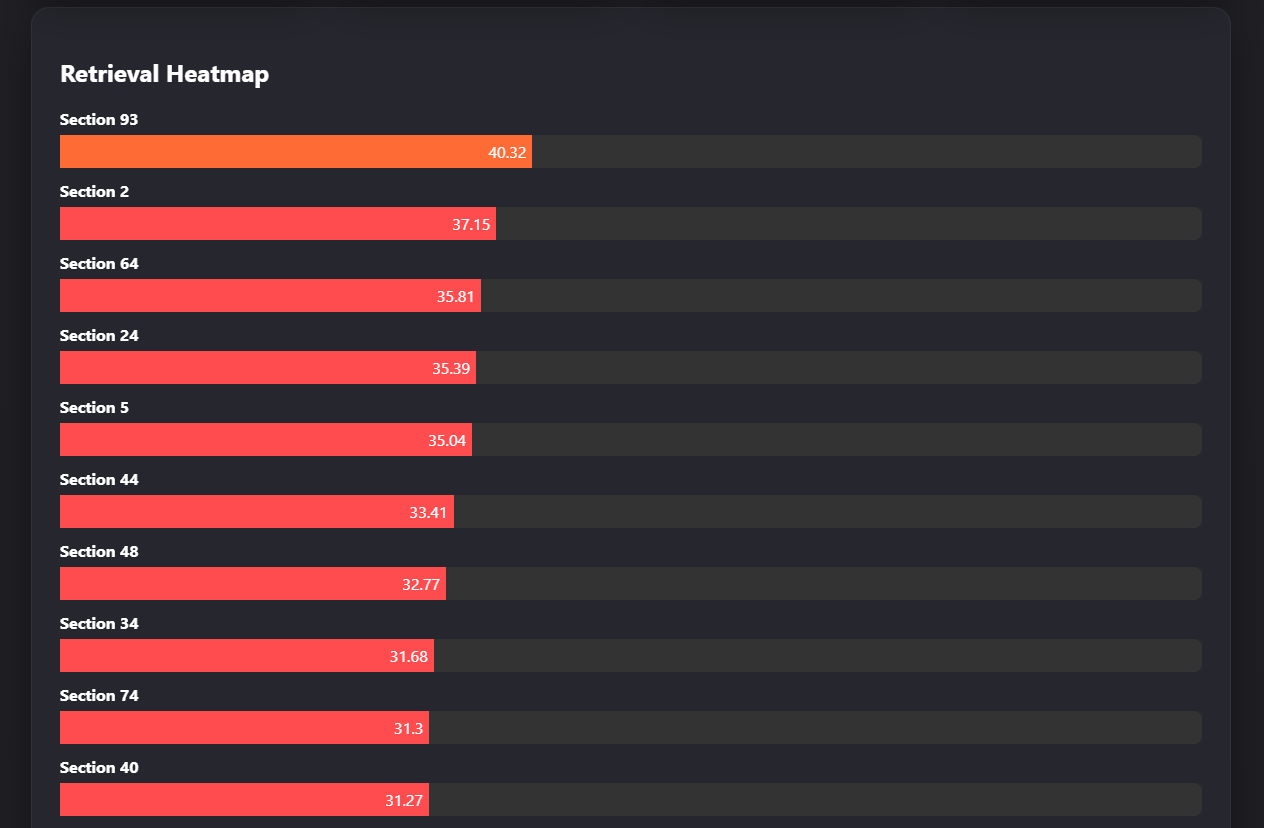
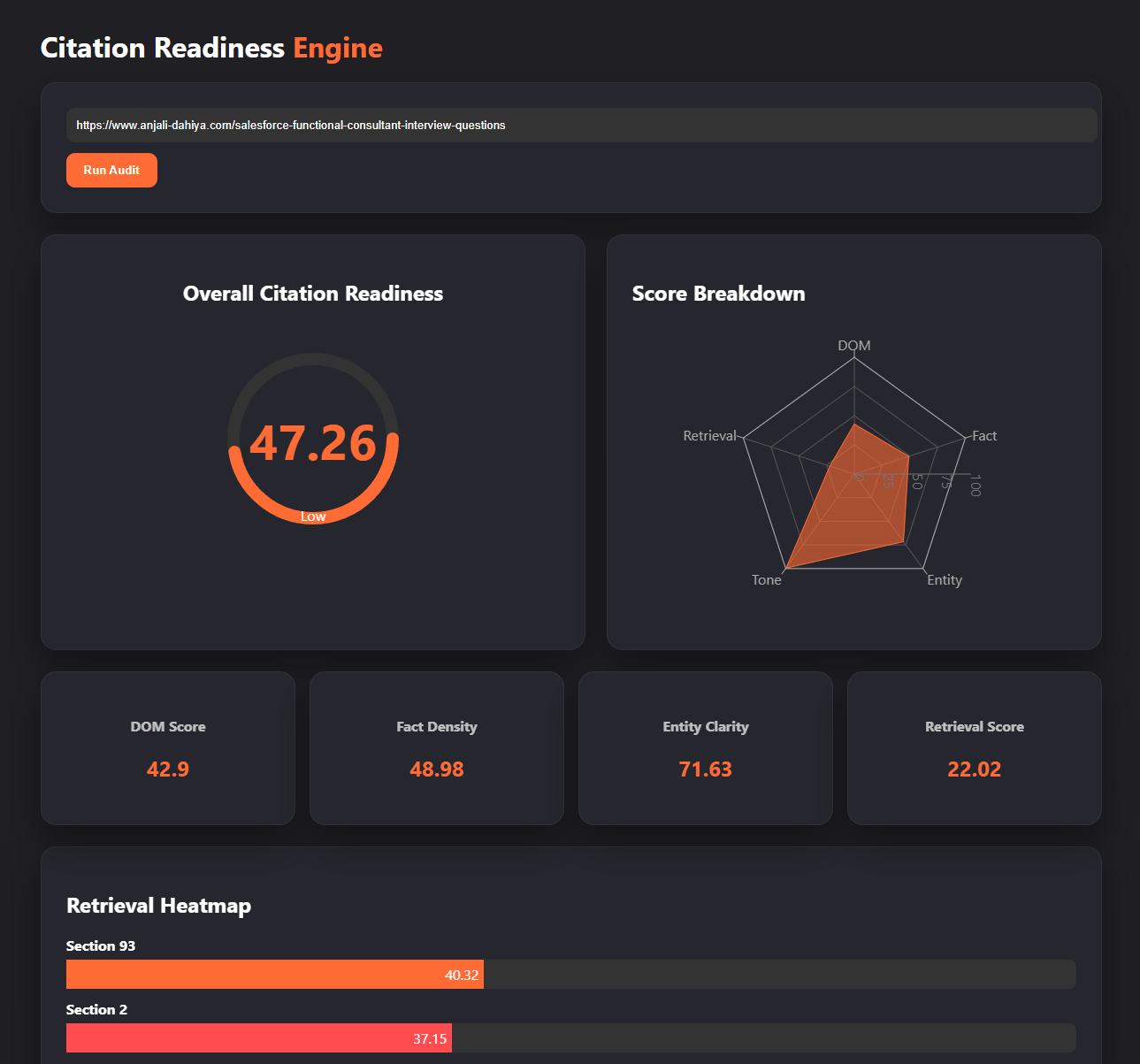
Uses Sentence Transformers, vector embeddings, and FAISS similarity search to simulate AI-style retrieval queries dynamically generated from detected entities. Computes section-level similarity dominance, retrieval strength ranking, weak block detection, and retrieval confidence heatmap. Approximates how AI systems choose which section to cite.
-
Deterministic Composite Citation Score
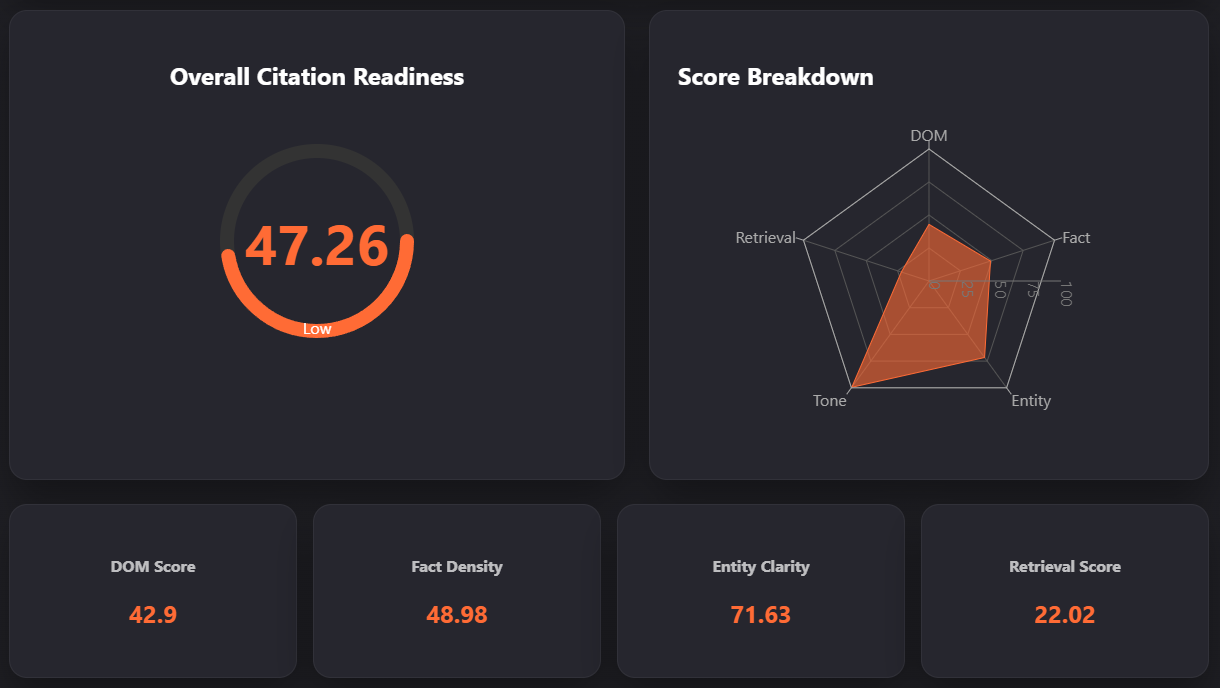
Combines weighted metrics including DOM extractability, informational density, entity coherence, tone neutrality, and retrieval dominance. Produces a Citation Readiness Index (CRI) from 0–100. Scoring logic is transparent and backend-authoritative.
-
Risk Flag Engine
Automatically detects structurally weak pages, entity fragmentation risk, sections with low retrieval strength, extractability suppression, and informational imbalance. Provides interpretable citation risk diagnostics.
-
Executive Intelligence Layer
Generates citation probability classification, section-level dominance ranking, weak segment detection, and retrieval suppression interpretation. Transforms raw metrics into explainable intelligence.
-
Executive Dashboard Interface
Visualizes animated CRI circular gauge, radar structural breakdown, color-coded metric cards, retrieval heatmap (ranked), risk severity panels, collapsible section intelligence, and backend-authoritative composite scoring. All visualizations render deterministic backend intelligence only.
-
Local-First Architecture
Runs entirely on FastAPI + PostgreSQL + spaCy + Sentence Transformers + FAISS backend with React + TypeScript frontend. No external AI APIs, no third-party citation prediction services, no black-box LLM scoring calls. All modeling is local, deterministic, and explainable.
The Challenge
AI-native retrieval systems change citation behavior.
Pages may rank well but fail to be cited because:
- Sections lack retrieval dominance
- Content blocks are not self-contained
- Entity reinforcement is inconsistent
- Structural segmentation is weak
- DOM complexity suppresses extractability
- Informational density is uneven
Traditional SEO tools cannot detect:
- Which sections are citation-ready
- Which segments suppress retrieval confidence
- Where entity drift occurs
- Where structural opacity reduces extractability
- Whether a page is AI citation optimized
There was no lightweight, self-hosted system capable of:
- Modeling citation extractability
- Simulating retrieval dominance
- Evaluating entity coherence
- Generating deterministic citation probability
- Producing section-level citation heatmaps
The Solution
Built a full-stack citation intelligence engine composed of:
Backend:
- FastAPI modeling API
- DOM structural analyzer
- Section segmentation engine
- Informational density modeling layer
- Entity coherence scoring
- Retrieval simulation via embeddings
- FAISS vector similarity indexing
- Risk flag engine
- Deterministic composite scoring system
- PostgreSQL-backed persistence
Frontend:
- React dashboard
- TypeScript strict typing
- Executive dark-mode UI
- Animated CRI circular gauge
- Responsive radar structural visualization
- Color-coded metric severity bands
- Retrieval heatmap ranking
- Collapsible section intelligence drill-down
The system enforces strict backend authority citation scores and retrieval intelligence cannot be manipulated client-side.
Why It Matters
As AI retrieval systems reshape search behavior, organizations must understand:
- Whether their content is citation-ready
- Which sections dominate retrieval
- Where structural weaknesses suppress extractability
- Where entity coherence breaks down
- How informational density impacts citation strength
This engine provides a deterministic, explainable framework for evaluating AI citation readiness.
It shifts content evaluation from keyword ranking analysis to structural extractability, retrieval dominance, and entity coherence intelligence modeling.
Future Expansion
- Persistent audit history
- Citation trend tracking
- Multi-URL competitive comparison
- AI-powered rewrite suggestions
- Configurable scoring weights
- Batch URL analysis
- Multi-page domain analysis
- Retrieval forecasting models
- SaaS-ready deployment architecture
- PDF executive reporting
Project Positioning Statement
This project represents a deterministic AI citation modeling infrastructure shifting content evaluation away from rank-based SEO reporting toward structural extractability, retrieval dominance, entity coherence, and citation likelihood intelligence for the AI-native search ecosystem.
Project Details
-
Category SEO Intelligence
-
Architecture Full-Stack
-
Year 2026
Tech Stack
Project Gallery