CTR Suppression Intelligence Engine - Baseline-Adjusted AI Search Impact Modeling Platform_
Statistical suppression modeling system designed to quantify interface-driven CTR loss using deterministic baseline scoring, volatility modeling, and revenue impact projection.
Project Overview
AI-driven search interfaces are fundamentally changing organic traffic behavior.
AI Overviews, enriched SERP features, and zero-click experiences reduce click-through rates even when rankings remain stable.
Traditional SEO tools track:
- Position changes
- Keyword visibility
- Traffic fluctuations
They do not:
- Isolate interface-driven suppression from ranking volatility
- Model expected CTR behavior by ranking position
- Quantify revenue exposure caused by AI-induced click loss
The CTR Suppression Intelligence Engine was built to solve that gap.
It ingests exported Search Console data, constructs historical CTR baselines, applies statistical validation, models volatility-adjusted risk scores, and quantifies revenue exposure all through deterministic backend modeling.
This is not a traffic comparison dashboard. It is a suppression modeling intelligence engine.
What It Does
The system ingests:
- Google Search Console query-level CSV exports
- Query, date, CTR, impressions, and average position data
- Configurable AI rollout cutoff date
Then computes:
- Position-Normalized CTR Baseline
- Expected CTR vs Actual CTR Deviation
- Ranking Stability Filtering
- Effective CTR Suppression Score
- Statistical Significance Validation (t-test)
- Revenue Loss Estimation
- 6-Month Revenue Exposure Projection
- Intent-Level Suppression Analysis
- Volatility-Adjusted Risk Score
- High-Risk Query Detection
Every metric is derived from deterministic backend modeling the frontend only renders computed results.
No synthetic demo metrics. No client-side scoring logic.
Core Capabilities
-
Baseline-Adjusted CTR Modeling
Builds historical expected CTR curves by ranking position and applies them to post-cutoff data to isolate suppression independent of ranking movement.
-
Ranking Stability Filtering
Removes queries with significant ranking shifts to prevent false suppression attribution.
-
Statistical Validation Engine
Uses two-sample statistical testing to determine whether CTR suppression is significant rather than noise.
-
Revenue Impact Modeling
Estimates revenue loss using lost clicks, conversion rate, and average order value. Provides query-level revenue exposure.
-
Volatility Scoring
Applies rolling suppression modeling to detect CTR instability and integrate volatility into risk scoring.
-
Intent Classification Engine
Classifies queries into informational, commercial, transactional, and navigational categories, then measures suppression intensity across intent types.
-
Deterministic Risk Scoring
Combines effective CTR loss, revenue exposure, statistical significance, and volatility factor to compute a final risk score and risk level classification.
-
Executive Intelligence Dashboard
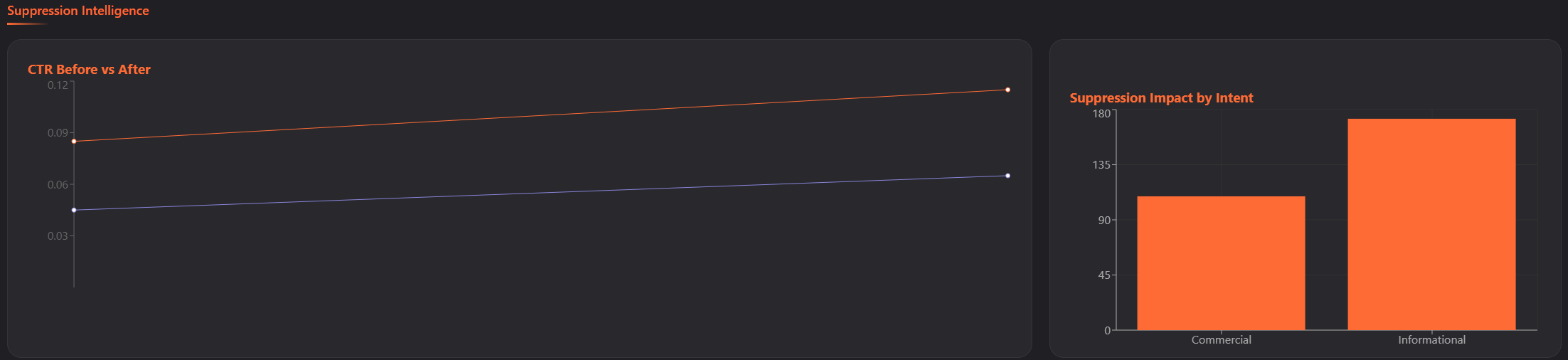
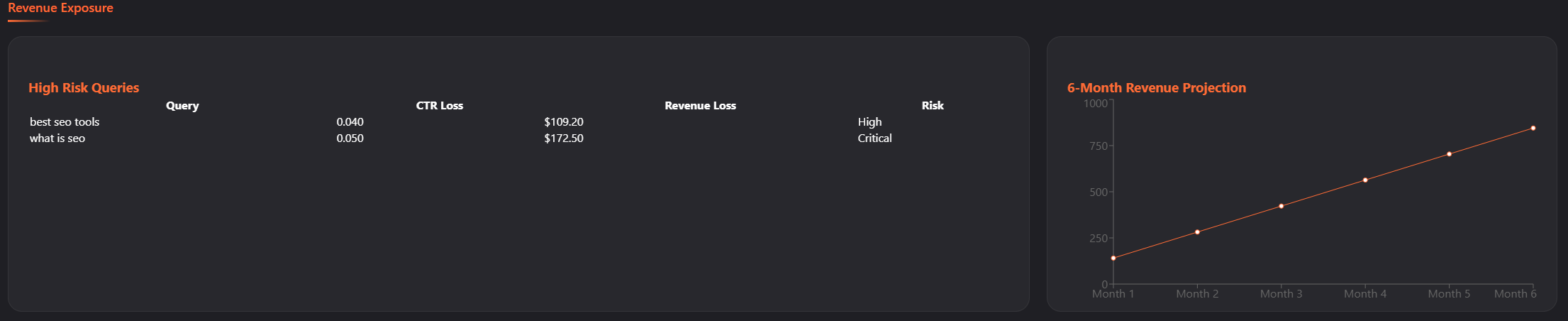
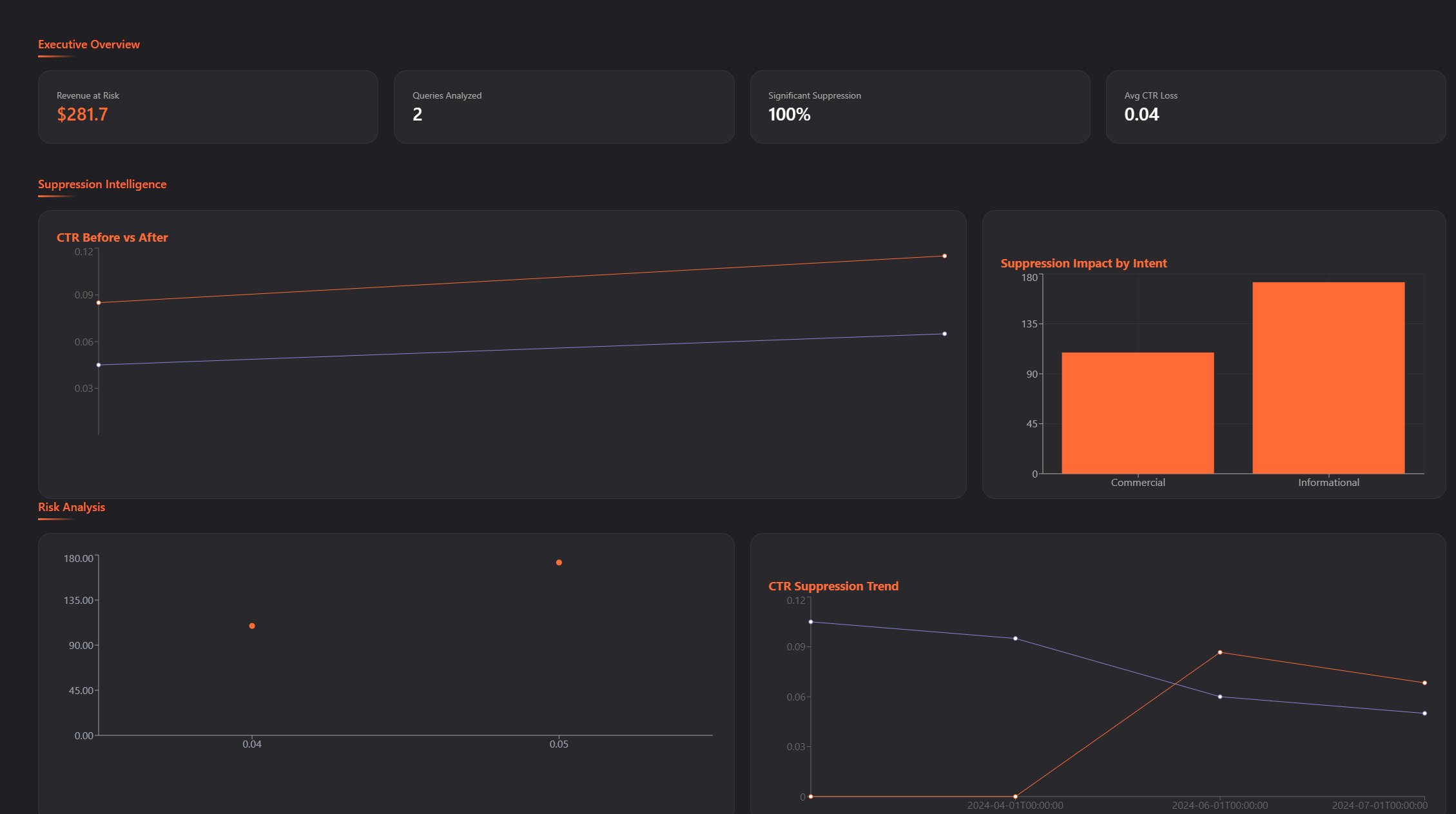
Visualizes revenue at risk KPIs, suppression heatmap, intent-level impact distribution, volatility trend modeling, high-risk query table, and 6-month revenue projection.
-
Local-First Architecture
Runs entirely on FastAPI + React with no external AI APIs or third-party black-box scoring services. All modeling logic is deterministic and server-side.
The Challenge
Modern search environments introduce interface-driven suppression that cannot be detected by:
- Rank tracking tools
- Visibility indexes
- Traditional SEO reporting
- Keyword position monitoring
Organic traffic declines may not correlate with ranking drops.
This creates analytical blind spots:
- Was the loss caused by ranking?
- Was it seasonal?
- Or was it interface-driven suppression?
There was no lightweight, self-hosted system capable of:
- Modeling expected CTR behavior
- Isolating suppression from rank volatility
- Quantifying revenue impact deterministically
- Integrating volatility into risk scoring
The Solution
Built a full-stack suppression intelligence engine composed of:
Backend:
- FastAPI modeling API
- Historical CTR baseline modeling
- Position-normalized expected CTR engine
- Ranking stability filter
- Statistical significance testing layer
- Volatility computation engine
- Revenue loss modeling logic
- Deterministic risk scoring system
- Structured JSON intelligence output
Frontend:
- React dashboard interface
- TypeScript strict typing
- Dark-mode executive UI
- Suppression heatmap visualization
- Intent impact bar modeling
- Volatility trend chart
- Revenue projection modeling
- High-risk query detection table
The system enforces strict backend authority risk scores and suppression metrics cannot be manipulated client-side.
Why It Matters
As AI interfaces reshape search behavior, businesses must understand:
- Which queries are structurally suppressed
- Where revenue exposure exists
- How volatility evolves post-AI rollout
- Which intent categories are most vulnerable
- Which queries represent strategic risk
This engine provides a measurable, deterministic framework for quantifying AI-driven CTR suppression.
It shifts suppression analysis from observational reporting to structured baseline modeling and statistical validation.
Future Expansion
- Direct Google Search Console API integration
- AI Overview detection simulation layer
- SERP feature exposure modeling
- Multi-domain suppression comparison
- Historical suppression tracking
- Multi-cutoff event modeling
- Automated narrative generation layer
- SaaS-ready multi-tenant architecture
- Persistent database storage
- Trend comparison between analysis runs
Project Positioning Statement
This project represents the architectural foundation for deterministic CTR suppression modeling shifting SEO analysis from rank-based reporting to baseline-adjusted, volatility-aware revenue exposure intelligence infrastructure for the AI search era.
Project Details
-
Category SEO Intelligence
-
Architecture Full-Stack
-
Year 2026
Tech Stack
Project Gallery