AI Retrieval & Commerce Engineering Platform – Scoped Retrieval Simulation, Entity Reinforcement Modeling & AI Transactability Infrastructure_
Scoped-first retrieval intelligence system designed to model AI visibility, prompt-level coverage, entity strength, structural extractability, and commerce API readiness using deterministic orchestration, defensive backend engineering, and scope-aware scoring architecture.
Project Overview
AI systems do not retrieve and reference brands the same way traditional search engines rank websites.
Large language models and AI-native interfaces prioritize contextual reinforcement across related pages, structured data clarity, entity consistency, prompt-topic coverage, extractable semantic blocks, internal linking signals, and API exposure for transactional responses.
Traditional SEO tools measure rankings, backlinks, traffic, keyword volatility, and SERP share. They do not model prompt-level retrieval probability, entity reinforcement strength, contextual authority modeling, cross-page semantic clustering, structured extractability, retrieval simulation coverage, or AI transactability readiness.
They do not approximate how AI systems construct answers across multiple context layers.
The AI Retrieval & Commerce Engineering Platform was built to solve that gap.
It executes scoped audits using a context-aware architecture, simulates retrieval probability across prompt universes, measures entity reinforcement patterns, evaluates structural extractability, and models commerce API exposure all under deterministic orchestration and defensive backend controls.
This is not an SEO dashboard. It is retrieval infrastructure engineering.
What It Does
The system begins with scoped URL discovery and intelligent context modeling. It ingests:
- Website sitemap and taxonomy
- Categorized URLs (product / category / blog / informational)
- Confirmed scope selection (single page, context cluster, category, full site)
- Structured HTML content
- JSON-LD and Schema.org data
- Product metadata and commerce attributes
- Prompt universe simulations
- Live LLM monitoring results
Then computes:
- AI Visibility Score (scope-aware)
- Retrieval Coverage Score
- Entity Strength Score
- Structured Clarity Score
- Commerce Readiness Score
- Prompt Coverage Modeling
- Retrieval Confidence Index
- Cross-Page Reinforcement Signals
- Gap Detection
- Competitive Coverage Delta
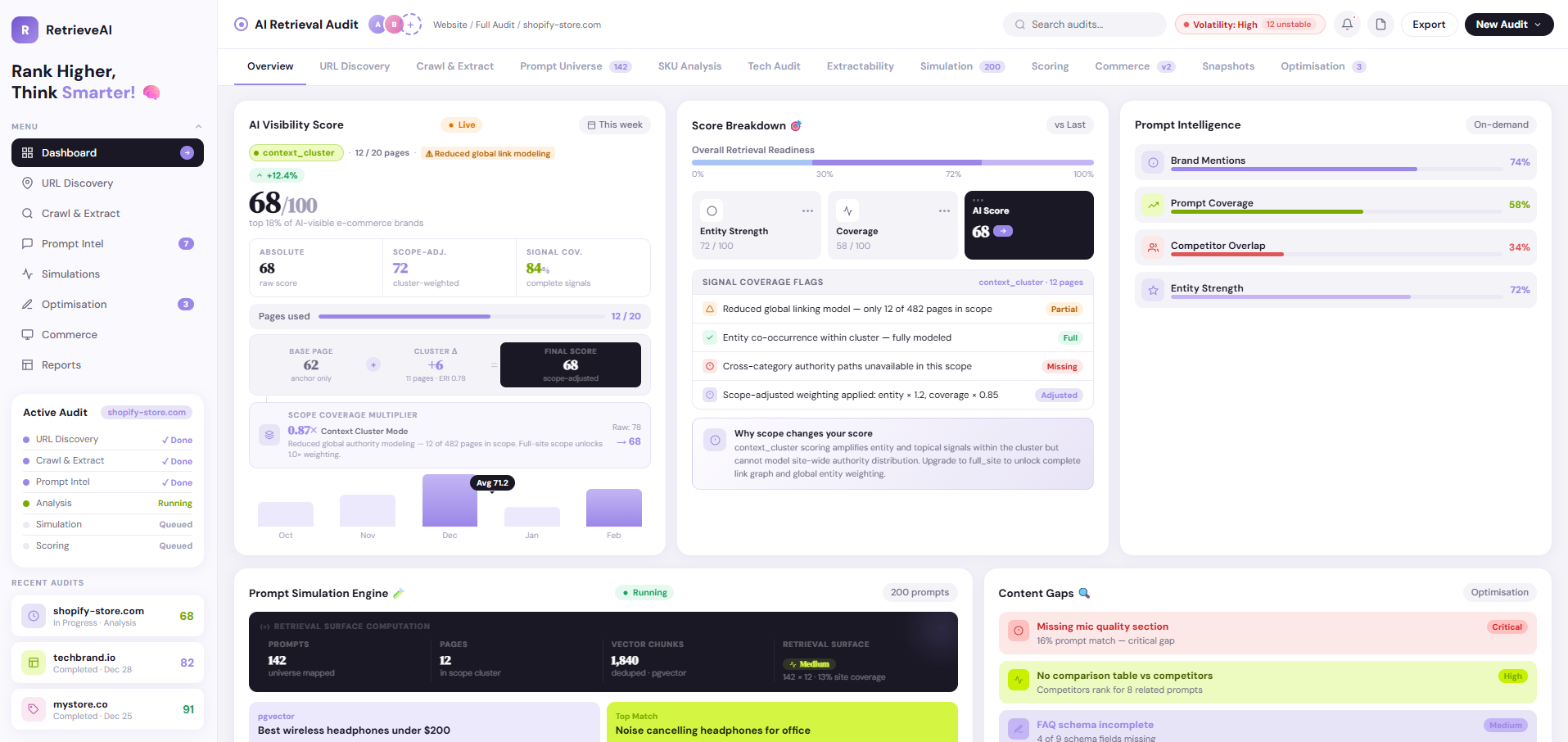
- Signal Flags for Reduced Context
Every metric is produced through deterministic backend orchestration. The frontend renders it does not compute.
No vanity metrics. No keyword heuristics. No client-side authority.
Core Capabilities
-
Scoped Retrieval Architecture
Uses a scoped-first model (single_page, context_cluster, category, full_site) enforcing hard page caps, prompt universe limits, scope-adjusted scoring weights, and contextual signal preservation. Reduces cost, preserves signal density, and prevents false authority modeling.
-
Intelligent Context Bundle Generation
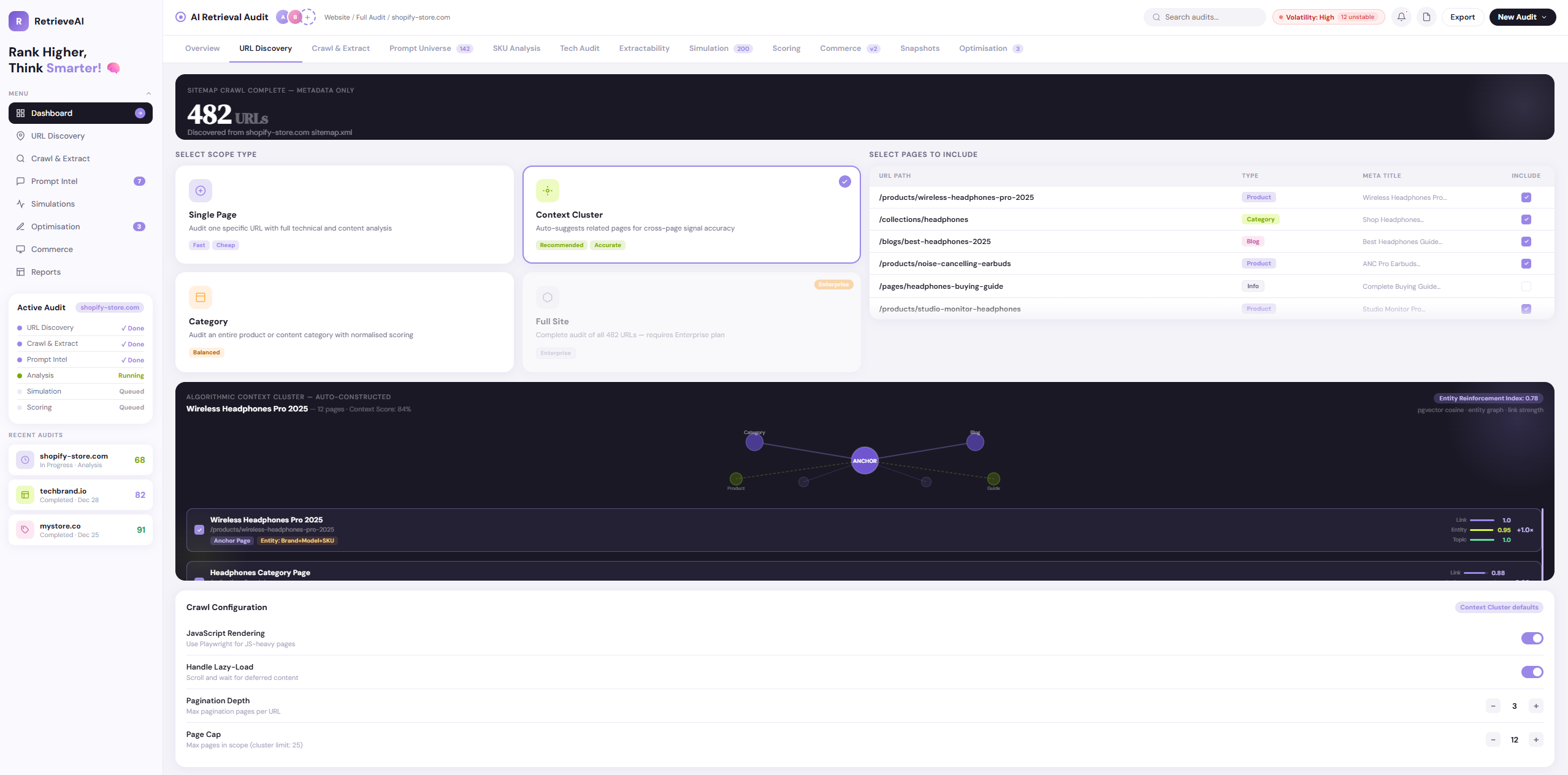
Auto-generates a context cluster including parent category, 3–5 sibling products, 2–3 related blog posts, homepage, and about page. Preserves internal link topology, entity reinforcement, topical clustering, and cross-page authority modeling without requiring a full-site crawl.
-
URL Discovery Engine
Performs lightweight reconnaissance before crawling: parses sitemap.xml (including index recursion), falls back to robots.txt hints, categorizes URLs, extracts metadata only, and detects pagination and taxonomy depth. No embeddings, no LLM calls, no heavy compute.
-
Crawl & Extraction Engine
Extracts full rendered DOM via Playwright, structured data (JSON-LD, Microdata, RDFa), SKU, pricing, availability, variant integrity, breadcrumbs, and API exposure signals. All wrapped in transaction-safe, idempotent orchestration.
-
Prompt Intelligence Layer
Simulates how AI systems discuss the brand. Generates category-based, comparison, budget, feature, and intent cluster prompts. Monitors LLM outputs to compute brand mention frequency, competitor comparison presence, citation URLs, positioning tone, and attribute association.
-
Retrieval Simulation Engine
Models retrieval probability via embedding similarity scoring (pgvector), prompt-page coverage modeling, cross-page reinforcement analysis, competitive coverage delta, and retrieval confidence classification. Includes chunk deduplication, batch processing, versioned cache keys, and deterministic temperature=0 LLM calls.
-
Scope-Aware Scoring Engine
Produces five primary dimensions: AI Visibility Score, Entity Strength Score, Structured Clarity Score, Retrieval Coverage Score, and Commerce Readiness Score. Scoring behavior adjusts by scope type to avoid misleading visibility inflation.
-
Defensive Infrastructure Architecture
Production-safe by design. Includes central audit orchestrator, soft-fail vs hard-fail phase policy, circuit breaker per vendor, retry service with exponential backoff, Postgres semaphore concurrency control, heartbeat-based slot cleanup, MAX_AUDIT_RUNTIME_MS timeout enforcement, snapshot immutability locking, versioned cache keys, usage ledger, and worker isolation from API thread.
-
Commerce Readiness Detection
Collects API endpoint exposure, structured product endpoints, storefront architecture signals, and structured commerce data integrity. Prepares for AI checkout readiness, tool-call compatibility, structured response compliance, and transaction modeling.
-
Executive Dashboard Interface
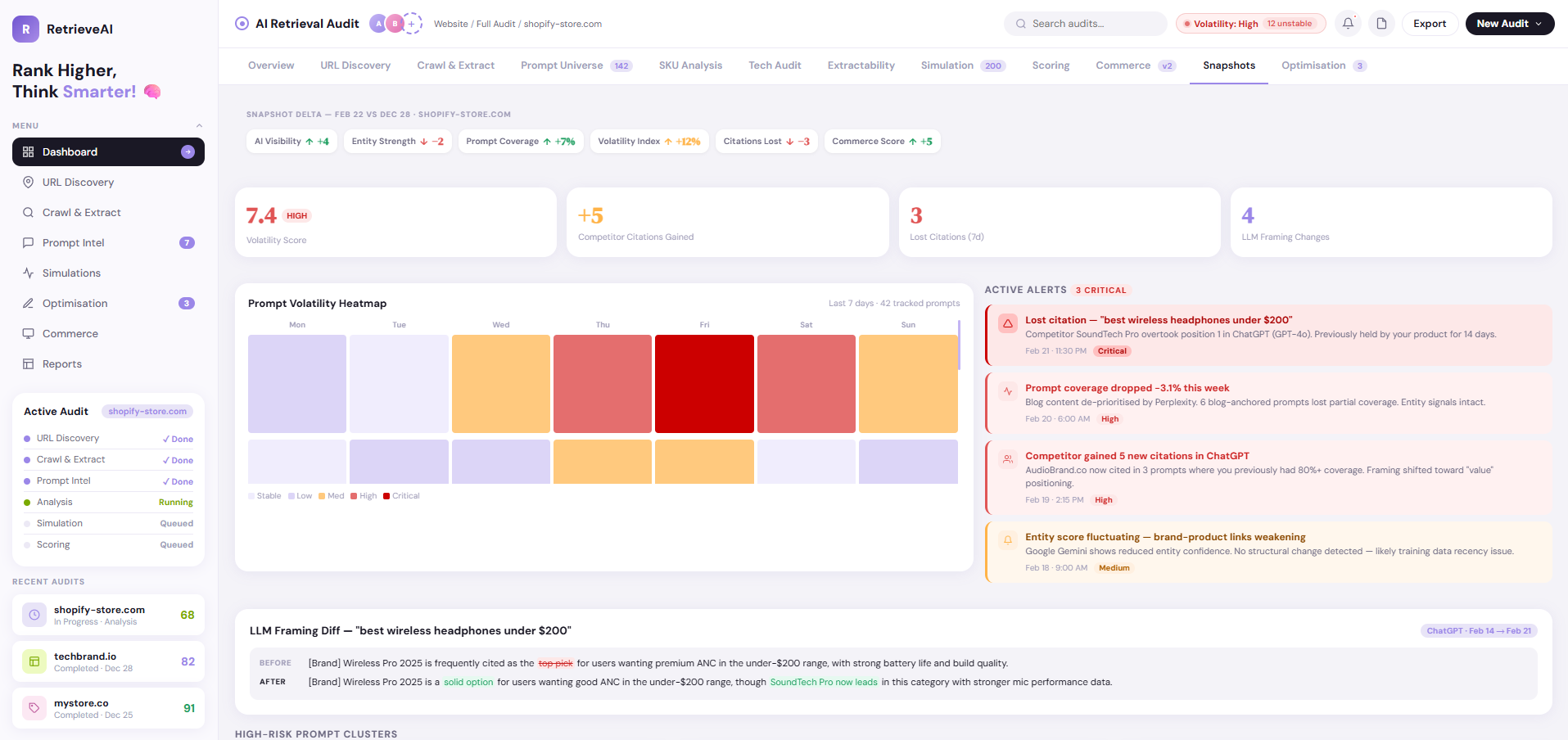
Visualizes animated AI Visibility Score, scope-adjusted signal flags, prompt coverage heatmaps, retrieval confidence rings, entity reinforcement breakdown, LLM monitoring distributions, crawl phase progression, gap detection pipeline board, snapshot comparison view, and context bundle confirmation interface.
The Challenge
AI-native interfaces change how brands are discovered. Pages may rank well but fail in AI retrieval because authority context is fragmented, entities are inconsistently reinforced, structured data is incomplete, internal linking lacks topical cohesion, prompt coverage is shallow, and product APIs are not AI-exposed.
Traditional SEO platforms cannot detect:
- Retrieval coverage gaps
- Prompt-level weakness
- Entity fragmentation
- Cross-page reinforcement failure
- Commerce API invisibility
- Reduced-context scoring risk
There was no scoped, context-aware, defensive infrastructure platform capable of modeling retrieval simulation, enforcing scope-adjusted scoring, preserving contextual authority, measuring entity reinforcement, tracking LLM mentions, simulating prompt coverage, and preparing brands for AI transactability.
The Solution
Built a full-stack retrieval and commerce engineering system composed of:
Backend:
- Node.js orchestration layer
- PostgreSQL + pgvector vector search
- Audit orchestrator service
- URL discovery engine
- Context bundle generator
- Crawl worker isolation process
- Structured extraction engine
- Prompt universe generator
- Retrieval simulation engine
- Entity modeling layer
- Scope-aware scoring engine
- Circuit breaker system
- Retry infrastructure
- Concurrency semaphore service
- Cache versioning layer
- Usage tracking ledger
- Snapshot immutability system
Frontend:
- React dashboard
- TypeScript strict typing
- Executive UI architecture
- Phase-based navigation
- Context cluster visualization
- Retrieval coverage rings
- Prompt simulation tables
- Gap detection pipeline
- Snapshot comparison mode
- Scope selector interface
All scoring authority remains server-side.
Why It Matters
As AI systems increasingly mediate brand discovery, businesses must understand whether they are retrievable, which prompts surface them, whether entity reinforcement is strong, whether coverage gaps exist, whether context is preserved, and whether APIs are AI-consumable.
This platform shifts visibility measurement from ranking metrics to retrieval infrastructure modeling. It moves from keyword tracking to scoped, entity-aware, context-preserving, commerce-ready AI visibility engineering.
Future Expansion
- Fully autonomous optimization engine
- Persistent audit storage
- Longitudinal visibility tracking
- Retrieval volatility monitoring
- Cross-site authority benchmarking
- Prompt coverage forecasting
- Commerce transaction simulation
- API transactability scoring
- SaaS multi-tenant architecture
- Batch enterprise audit orchestration
- AI-native improvement recommendation engine
Project Positioning Statement
This project represents the architectural foundation for scoped AI retrieval and commerce engineering shifting visibility analysis from rank-based SEO measurement to deterministic retrieval simulation, entity reinforcement modeling, scope-aware scoring, and AI transactability infrastructure for the AI-mediated discovery era.
Project Details
-
Category AI Retrieval Intelligence
-
Architecture Full-Stack
-
Year 2026
Tech Stack
Project Gallery