RankScan – Multi-Provider AI Visibility Analytics & Competitive Intelligence Platform_
Full-stack AI visibility monitoring system designed to track brand presence, sentiment distribution, citation sources, and competitive share-of-voice across major AI platforms using direct-SQL architecture, provider orchestration, and real-time analytics dashboards.
Project Overview
AI-native search platforms are increasingly shaping brand discovery.
Users now search through ChatGPT, Gemini, Claude, Perplexity, and Google AI Overview instead of traditional SERPs. Brands are no longer ranked they are mentioned, compared, cited, and contextualized.
Traditional SEO tools measure keyword rankings, backlinks, traffic, and SERP position. They do not measure AI platform brand mentions, share of voice inside AI responses, sentiment distribution across providers, citation source tracking, competitive comparison inside generated answers, or prompt-level brand performance.
RankScan was built to monitor and quantify AI visibility across multiple large language model platforms.
This is not a keyword tracker. It is an AI visibility analytics system.
What It Does
RankScan ingests:
- Configurable prompts
- Brand definitions
- Competitor domains
- Multiple AI providers (API + scraper modes)
- Scheduled execution rules
- Workspace-scoped configurations
Then computes:
- Brand visibility score
- Share-of-voice percentage
- Sentiment distribution
- Citation source extraction
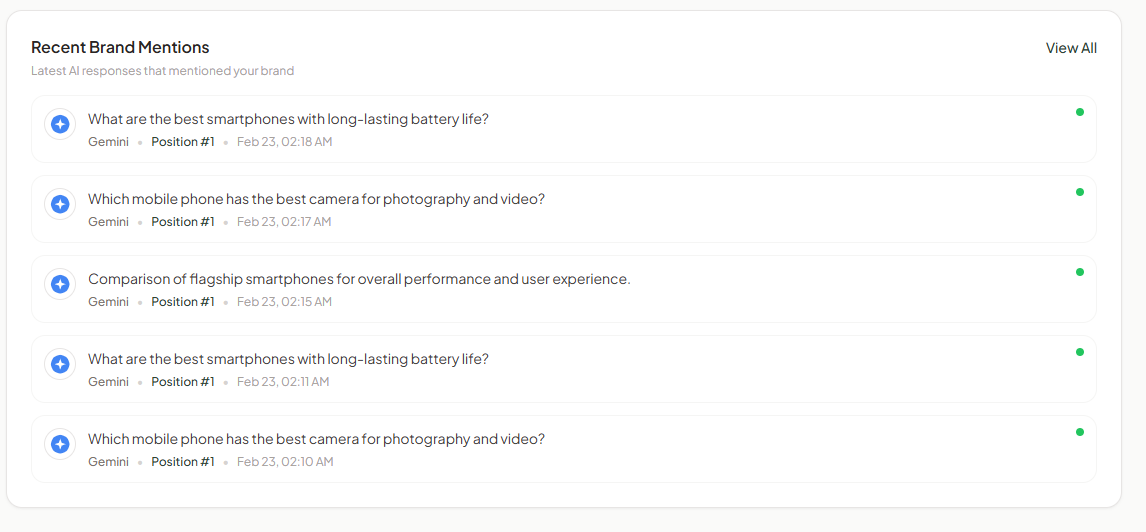
- Competitive mention tracking
- Leaderboard ranking
- Prompt performance analytics
- Provider health metrics
All results are persisted in PostgreSQL and rendered in a real-time analytics dashboard.
Core Capabilities
-
Multi-Provider AI Orchestration
Integrates official APIs (OpenAI, Claude, Gemini, Perplexity) and headless browser scrapers (ChatGPT Web, Claude Web, Gemini Web, Google AI Overview) via a provider abstraction layer, base provider classes, response normalization utilities, circuit breaker failure protection, and provider health monitoring.
-
Workspace-Based SaaS Architecture
Designed as a multi-tenant analytics platform with user authentication, isolated workspaces, workspace-specific brands, workspace-level competitors, topic-based prompt grouping, and per-workspace analytics. Enables managing multiple brands or clients under one account.
-
Opaque Token Authentication
Implements random opaque tokens stored in database with immediate token revocation, token expiry tracking, no JWT signature complexity, and server-side validation control. Provides full session control and auditability.
-
Direct SQL (No ORM) Architecture
No ORM abstraction uses direct parameterized SQL, transaction wrappers, query helpers (query, queryOne, queryAll, transaction), connection pooling with statistics, and migration-based schema evolution. Maximizes transparency and performance.
-
Scheduled Prompt Execution Engine
Allows automated prompt runs with configurable execution intervals, execution rate limiting, background scheduler service, and execution history persistence. Enables continuous AI visibility monitoring.
-
Sentiment Analysis Pipeline
Processes AI responses to compute positive, neutral, and negative mentions with sentiment percentages per provider and sentiment trend visualization. Uses Gemini for analysis provider configuration.
-
Citation Extraction & Tracking
Extracts referenced URLs, domain names, source types (blog, forum, corporate, academic, etc.), citation frequency per domain, and competitive citation comparison. Provides a full citation analytics dashboard.
-
Competitive Intelligence Layer
Tracks competitor mentions per prompt, cross-provider competitive presence, leaderboard rankings, share-of-voice metrics, and comparative visibility heatmaps. Enables AI-native benchmarking.
-
Provider Health Monitoring
Maintains API latency tracking, consecutive failure count, circuit breaker state, health logs in database, and provider availability analytics. Prevents cascading provider failures.
-
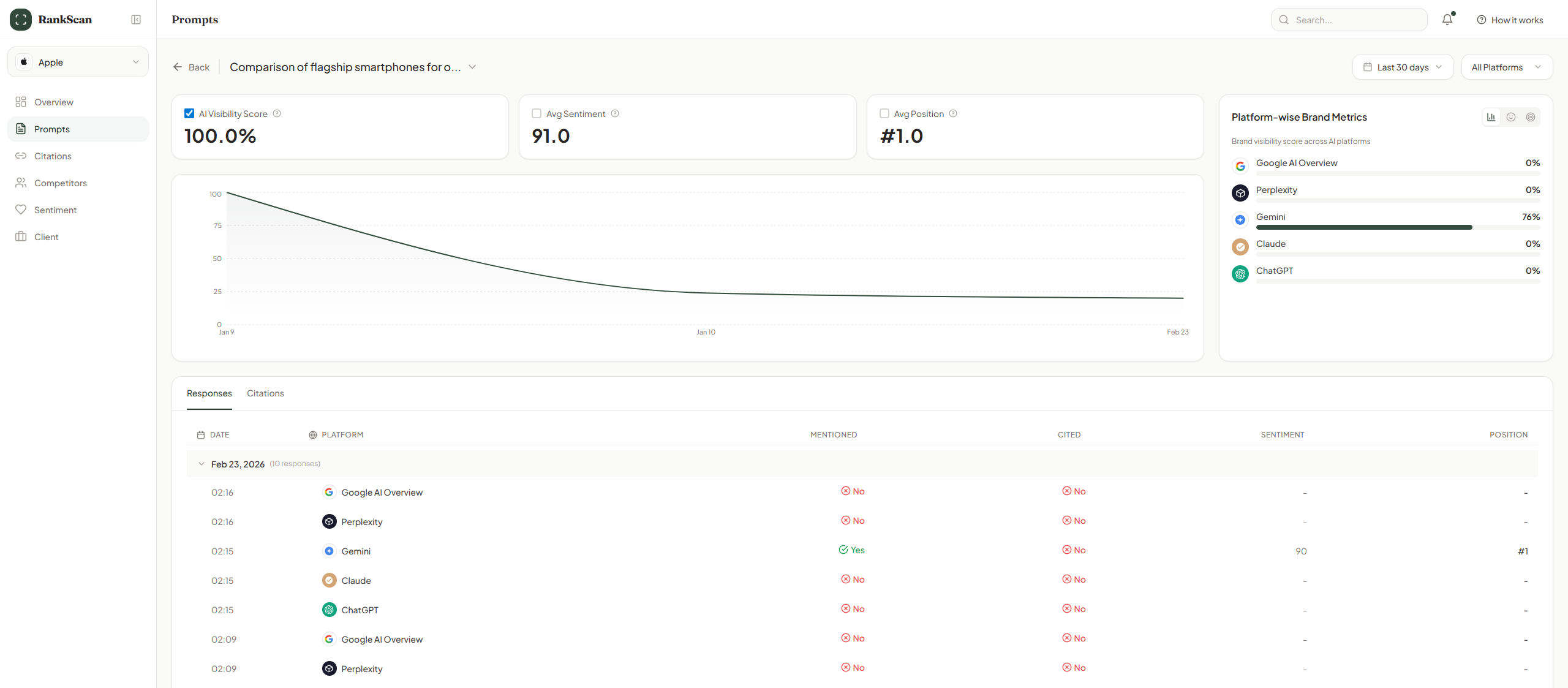
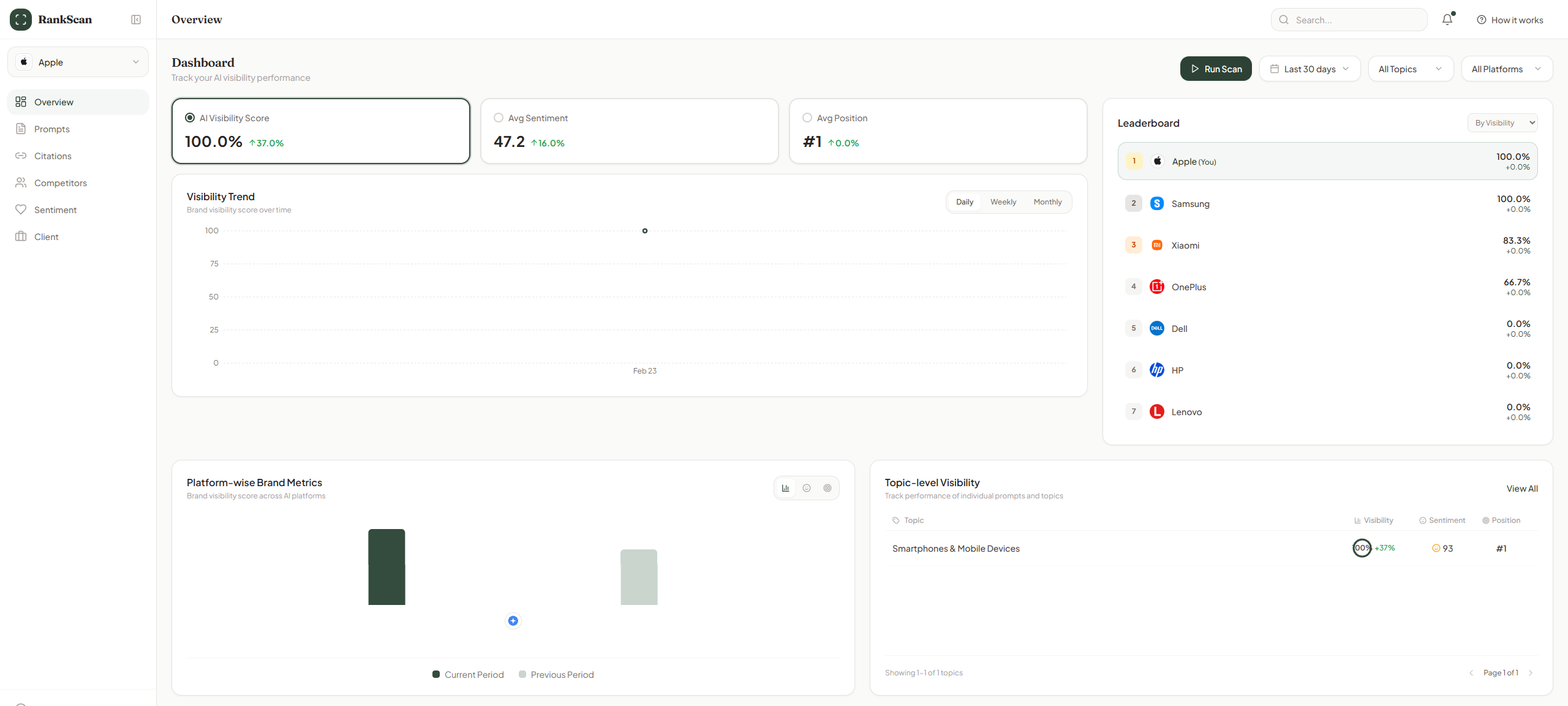
Real-Time Analytics Dashboard
Built with React 18, TypeScript strict mode, Vite, TailwindCSS, and Recharts. Includes visibility score charts, share-of-voice pie charts, sentiment breakdown graphs, leaderboard tables, citation analytics, prompt analytics, workspace switching, and an onboarding wizard with AI suggestions. All backed by typed service layer and centralized API configuration.
The Challenge
AI platforms do not expose ranking APIs. They generate responses dynamically. Visibility cannot be measured using traditional SEO crawlers, SERP trackers, or keyword ranking APIs.
Additionally:
- AI responses vary by provider
- Sentiment differs by context
- Citations may or may not appear
- Providers may fail unpredictably
- Scrapers may break
- APIs may rate-limit
Building a reliable AI visibility monitoring system required multi-provider abstraction, failure isolation (circuit breaker), rate limiting, execution scheduling, database persistence, strict typing, and workspace-level isolation.
There was no existing lightweight, developer-controlled system for tracking brand mentions across AI, monitoring competitive share-of-voice, extracting citation sources, running scheduled prompt analytics, persisting structured AI response data, and providing full-stack analytics dashboards.
The Solution
Built a production-grade AI visibility analytics platform composed of:
Backend:
- Node.js + Express REST API
- Strict TypeScript configuration
- Direct PostgreSQL integration (no ORM)
- Migration-based schema management
- Opaque token authentication
- In-memory rate limiting
- Provider abstraction layer
- Circuit breaker pattern
- Scheduler service
- AI response normalization
- Citation extraction service
- Sentiment analysis service
- Metrics aggregation service
- Provider health monitoring
- Workspace-based multi-tenancy
Frontend:
- React 18
- TypeScript strict mode
- Vite build system
- TailwindCSS custom theme
- Recharts data visualization
- Modular page architecture
- Custom hooks (useAuth, useWorkspace, useApi, useGemini)
- Centralized API endpoint config
- Workspace-aware routing
- Onboarding wizard
- Real-time analytics views
All analytics logic resides server-side. The frontend renders computed metrics only.
Why It Matters
As AI systems increasingly mediate brand discovery, companies need to know whether their brand is being mentioned, which provider mentions them most, whether sentiment is positive or negative, which sources are cited, how competitors compare, which prompts surface them, and whether visibility is trending upward or downward.
RankScan shifts visibility monitoring from keyword ranking to AI mention analytics. It provides structured, persistent intelligence for the AI-native search era.
Future Expansion
- Longitudinal visibility trend forecasting
- Automated alerting system
- Subscription & billing integration
- Enterprise team management
- Advanced prompt experimentation
- AI-powered competitor discovery
- Citation quality scoring
- Exportable executive reports
- Provider-level weighting models
- AI volatility detection
Project Positioning Statement
RankScan represents a full-stack AI visibility analytics infrastructure transforming brand monitoring from traditional SERP tracking to multi-provider AI mention intelligence, competitive share-of-voice modeling, citation tracking, and sentiment analytics for the generative search era.
Project Details
-
Category AI Visibility Analytics
-
Architecture Full-Stack
-
Year 2026
Tech Stack
Project Gallery